7 Best Cookware Materials for Your Kitchen: Pros, Cons & Best Uses
Choosing cookware is not only about finding the right size, shape, or brand. The material of your cookware can affect how quickly it heats, how well it retains heat, how easy it is to maintain, and how long it may last.
That’s why it helps to understand different cookware materials before buying a new pan, pot, tawa, kadai, or cookware set.
Stainless steel, cast iron, carbon steel, aluminium, copper, and other materials all behave differently in the kitchen. There is no single material that is perfect for every type of cooking.
For example, you may prefer stainless steel for everyday cooking, cast iron for high-heat cooking and excellent heat retention, or non-stick cookware when easy food release is your priority.
In this guide, we will look at seven important cookware materials, their main strengths and limitations, and the types of cooking they are best suited for.
Quick note: Non-stick is not a metal. It is generally a coating applied over a cookware base material. We discuss it separately because it is one of the most common cookware choices in modern kitchens.
1. Stainless Steel
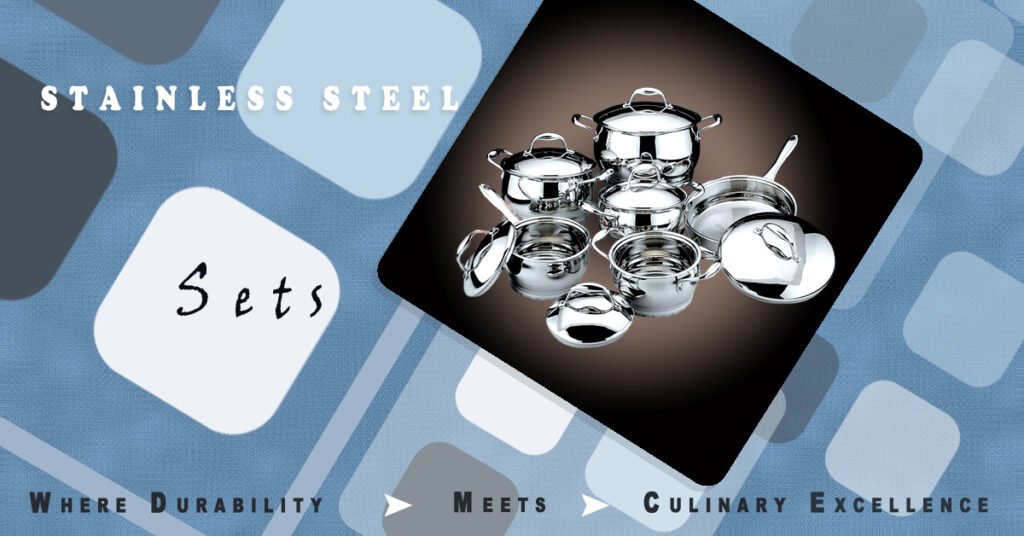
Stainless steel is one of the most widely used cookware materials because it offers a useful combination of durability, versatility and relatively easy maintenance.
It is made primarily from iron along with elements such as chromium and, depending on the grade, nickel and other metals. Chromium helps stainless steel resist corrosion by forming a protective oxide layer on the surface.
Why choose stainless steel?
Stainless steel cookware can be useful for a wide range of everyday cooking tasks, including:
- Cooking rice and dal
- Preparing curries and gravies
- Boiling vegetables
- Making soups
- Sautéing
- Frying
- Preparing sauces
One limitation is that plain stainless steel does not conduct heat as efficiently as materials such as aluminium or copper.
This is why many better-quality stainless steel cookware pieces use multi-layer construction, such as tri-ply cookware, where aluminium or another conductive layer is combined with stainless steel.
Advantages
- Durable
- Resistant to corrosion
- Suitable for many cooking methods
- Easy to maintain
- Available in a wide range of prices
- Many varieties are suitable for induction
Things to consider
Food may stick to stainless steel when the pan is not preheated properly or used at the right temperature. Preheating the cookware and using appropriate heat and oil can make cooking easier.
Best suited for
Everyday cooking and long-term kitchen use.
If you want to learn more about this material, see our detailed guide:
Stainless Steel Cookware: 9 Essential Tips
And for readers specifically looking for a set:
Best Stainless Steel Cookware Sets on Amazon India (2026)
2. Cast Iron
Cast iron is valued for its excellent heat retention and durability.
It takes longer to heat than some lighter cookware materials, but once heated, it can maintain a relatively stable temperature for longer.
This makes cast iron particularly useful for cooking that benefits from strong, steady heat.
Where cast iron works well
Cast iron can be useful for:
- Searing
- Shallow frying
- Deep frying
- Making rotis and dosas
- Grilling
- Slow cooking
- Baking
A properly seasoned cast iron surface can also develop good food-release properties over time.
However, cast iron requires more care than stainless steel.
Advantages
- Excellent heat retention
- Extremely durable
- Suitable for high-temperature cooking
- Can be used for many cooking methods
- Can last for many years with proper care
Things to consider
Cast iron cookware can be heavy. It can also develop rust if it is repeatedly exposed to moisture without proper drying and maintenance.
Seasoning is an important part of maintaining traditional cast iron cookware.
Best suited for
High-heat cooking, searing, frying, tawas and slow cooking.
For a deeper guide, readers can continue to:
7 Powerful Reasons Why Cast Iron Cookware Is a Must-Have in Every Kitchen
3. Carbon Steel
Carbon steel is another iron-based cookware material, but it is generally thinner and lighter than traditional cast iron.
It can heat relatively quickly while still offering strong heat retention and high-temperature performance.
Carbon steel is particularly popular for cooking methods that require a hot cooking surface.
Where carbon steel works well
It can be useful for:
- Stir-frying
- Searing
- Frying
- Grilling
- Making flatbreads
- High-heat cooking
Like cast iron, carbon steel can build up a natural non-stick layer over time with regular seasoning.
Advantages
- High-heat capable
- Lighter than many cast iron pieces
- Good heat response
- Durable
- Can develop a naturally seasoned surface
Things to consider
Carbon steel needs appropriate care to prevent rust.
The cooking surface may also change appearance as it becomes seasoned. This is normal and is part of the character of the material.
Acidic foods can also be less suitable for a newly seasoned carbon steel surface, particularly during the early stages of seasoning.
Best suited for
High-heat cooking and cooks who want a durable alternative to cast iron.
For a detailed guide, readers can also continue to: Why Carbon Steel Utensils Are Great for Your Kitchen
4. Aluminium
Aluminium is valued mainly for its excellent heat conductivity and relatively light weight.
It heats quickly and can distribute heat efficiently, which makes it useful for everyday cookware.
Aluminium cookware is available in many forms, including basic aluminium, pressure cookers, kadais, frying pans and cookware with other materials or coatings.
Advantages
- Lightweight
- Heats quickly
- Good heat conductivity
- Usually affordable
- Easy to handle
Things to consider
Bare aluminium is softer than stainless steel and can be more susceptible to scratches and surface wear.
The exact suitability also depends on how the cookware is finished or constructed. Some aluminium cookware has a protective treatment or coating, while other pieces use aluminium as part of a multi-layer construction.
Aluminum cookware can release small amounts of aluminum into food, depending on the cookware and cooking conditions. For more information about cookware materials and their possible effects on food, see MedlinePlus’s guide to cooking utensils and nutrition.
Best suited for
Lightweight everyday cookware and pieces where quick heating is useful.
5. Copper
Copper is known for its excellent thermal conductivity and rapid response to temperature changes.
This means copper cookware can heat and cool quickly when the heat source is adjusted.
That level of responsiveness can be useful when precise temperature control matters.
Why is copper different?
Compared with many other cookware materials, copper responds very quickly to changes in heat.
However, copper can react with certain foods. For this reason, copper cookware intended for regular cooking is commonly lined with another material, such as stainless steel.
Advantages
- Excellent thermal conductivity
- Very responsive to temperature changes
- Attractive appearance
- Useful when precise heat control matters
Things to consider
- Usually more expensive
- Requires more maintenance
- Often requires an interior lining
- The exterior may need polishing if you want to maintain its appearance
Best suited for
Specialized cooking where precise temperature control is important.
For most households, copper is not essential simply because it conducts heat extremely well. Its advantages need to justify its additional cost and maintenance.
6. Hard-Anodized Aluminium
Hard-anodized cookware starts with aluminium but undergoes an electrochemical treatment that creates a harder surface.
It retains many of aluminium’s heat-conducting advantages while providing a harder and more durable surface than untreated aluminium.
Hard-anodized cookware is commonly available in frying pans, kadais, saucepans and cookware sets.
Advantages
- Good heat conductivity
- Lighter than cast iron
- Harder surface than untreated aluminium
- Suitable for everyday cooking
- Available in many shapes and sizes
Things to consider
Not all hard-anodized cookware is identical.
Some products may also have an additional non-stick coating, while others have a different cooking surface. Therefore, it is important to check the manufacturer’s specifications rather than assuming every hard-anodized product behaves the same way.
Best suited for
Home cooks who want lightweight cookware with good heat performance and a harder aluminium surface.
7. Non-Stick Coated Cookware
Non-stick deserves a place in this comparison even though it is not a metal.
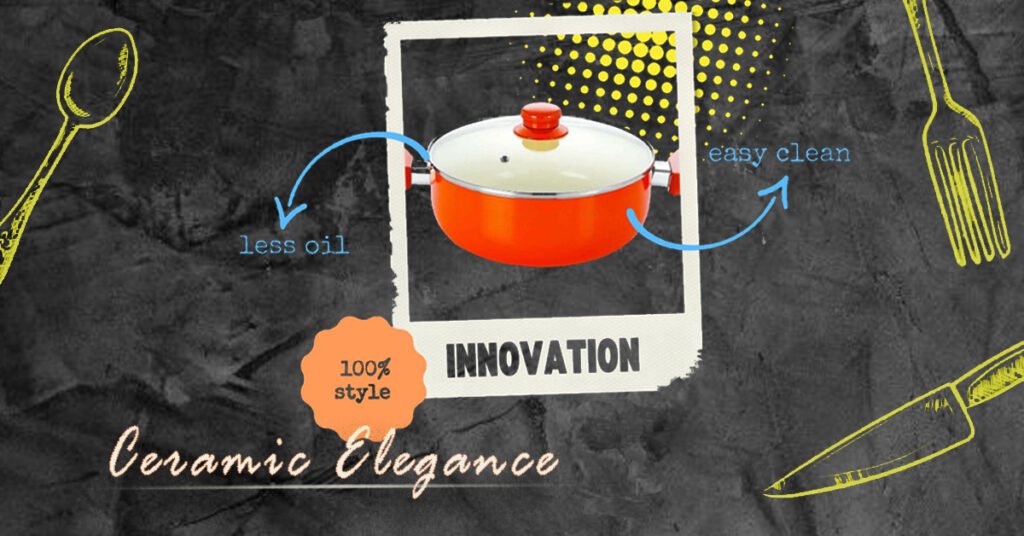
The term describes a cooking surface designed to reduce food sticking. The underlying cookware may be made from aluminium, stainless steel, or another material.
Common non-stick systems include PTFE-based coatings and ceramic-based coatings, depending on the product.
Why do people choose non-stick cookware?
The biggest attraction is simple:
Food releases easily and cleanup is usually easier.
This can be especially useful for:
- Eggs
- Omelettes
- Pancakes
- Crepes
- Fish
- Delicate foods
- Low-oil cooking
Advantages
- Easy food release
- Easy cleanup
- Requires relatively little cooking oil
- Useful for delicate foods
- Convenient for everyday cooking
Things to consider
The coating requires appropriate care.
Using unsuitable utensils, excessive heat, abrasive cleaning methods, or ignoring the manufacturer’s care instructions can shorten the useful life of the cooking surface.
Different non-stick coatings also have different characteristics, when using non-stick cookware, follow the manufacturer’s instructions for heating and care. The US Food and Drug Administration (FDA) explains how substances used in food-contact materials are evaluated for safety.
For a more detailed guide, see:
Non-Stick Cookware: 7 Simple Steps to Choose the Best for Your Kitchen
How Should You Choose Between These Cookware Materials?
It cannot be said that cookware made of any single specific material is the best choice for the kitchen. The right choice depends on what you cook, how often you cook, and what matters most to you, such as durability, heat control, easy cleaning, or lightweight handling.
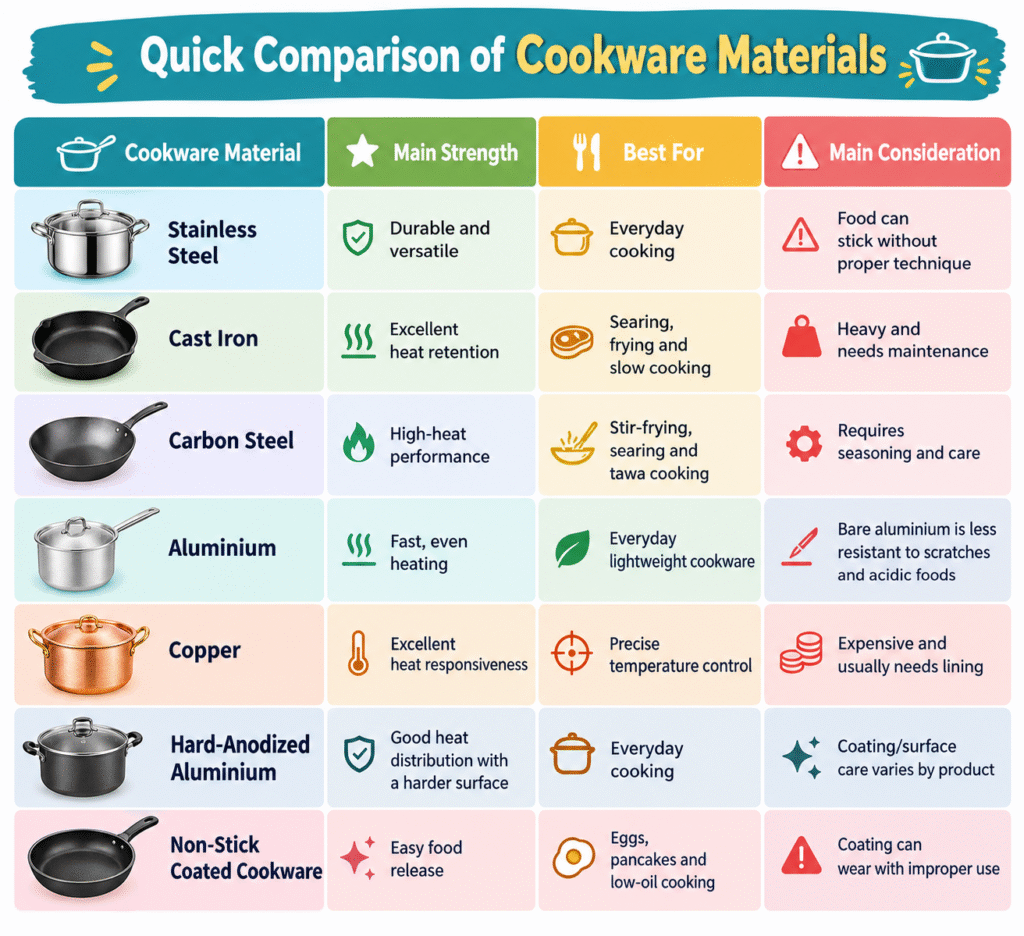
Let us compare the cookware materials here :
For everyday cooking:
Stainless steel is a versatile option if you want durable cookware that can handle a wide range of everyday dishes.
For better heat retention:
Cast iron holds heat for a long time, making it useful for slow cooking, frying, and dishes that benefit from steady heat.
For high-heat cooking:
Carbon steel is worth considering for searing, stir-frying, and other cooking methods that use high heat.
For lightweight cookware:
Aluminium heats up quickly and is easy to lift and handle, making it a practical choice for everyday use.
For precise heat control:
Copper responds quickly to changes in temperature, which can be helpful when you need more control while cooking. However, it usually costs more and may need extra care.
For a durable aluminium option:
Hard-anodized aluminium offers good heat conductivity along with a harder, more durable surface than regular aluminium cookware.
For easy food release:
Non-stick cookware is convenient for foods such as eggs, pancakes, and other delicate dishes. If you need to eat food cooked with less oil for health reasons, you should certainly opt for non-stick cookware.
The key is to choose the material that fits your cooking habits and kitchen needs, rather than simply choosing the most expensive or popular option.
Which Cookware Material Is Best for an Indian Kitchen?
There is no single answer because Indian cooking includes many different techniques.
A household that regularly prepares dal, rice, curries and vegetables may prefer stainless steel.
Someone who frequently makes rotis, dosas or uses high heat may appreciate cast iron or carbon steel.
A cook who prepares eggs, pancakes or delicate foods may prefer a non-stick pan.
The important point is that your cookware collection does not have to use only one material.
A practical kitchen can combine different materials according to the cooking task.
For example:
- Stainless steel pot for dal and curries
- Cast iron tawa for rotis or dosa
- Non-stick pan for eggs
- Carbon steel pan for high-heat cooking
The right combination depends on your cooking habits, budget, storage space and maintenance preferences.
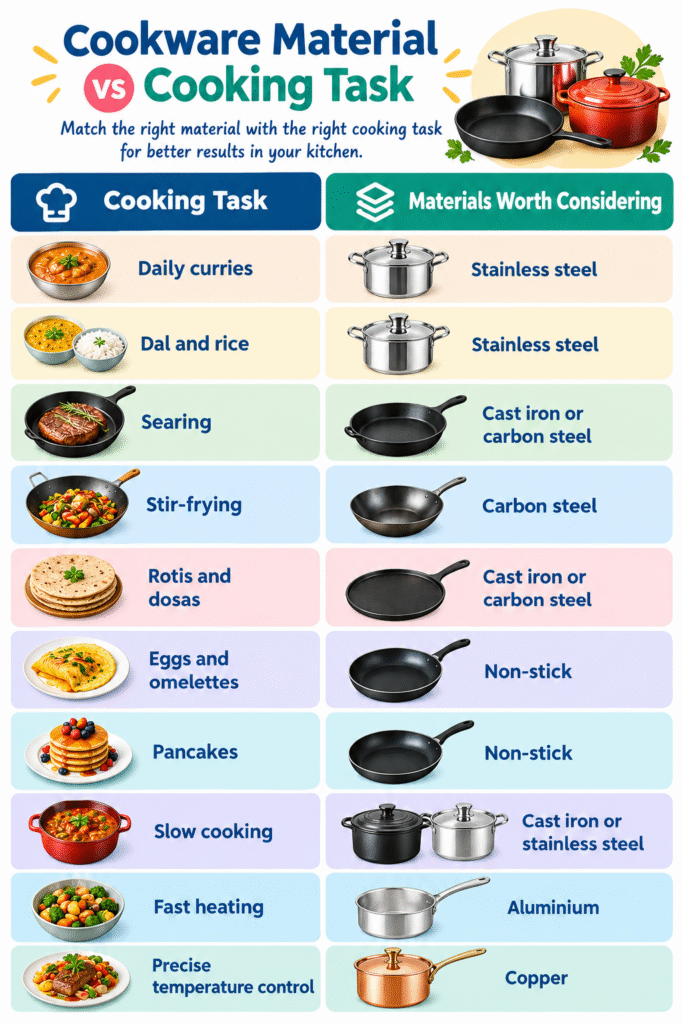
This table is only a starting point. The actual performance also depends on cookware thickness, construction, heat source, coating, design and how the cookware is used.
What About Triply Cookware?
Triply cookware deserves special attention because it combines different materials rather than relying on one metal alone.
A typical tri-ply construction may use stainless steel on the cooking surface with a conductive aluminium layer between stainless-steel layers.
The purpose is to combine the durability and cooking surface characteristics of stainless steel with better heat distribution from the conductive core.
This is one reason triply stainless steel cookware has become popular among people looking for durable everyday cookware with improved heat distribution.
If you are specifically interested in this category, our detailed stainless steel cookware guide goes deeper into construction, sizes, features and buying considerations.
How to Choose the Right Cookware Material: 6 Simple Questions
Before buying cookware, ask yourself these six questions:
1.What do I cook most often?
Your cooking habits should influence the material you choose.
2. Do I use gas or induction?
Not every cookware piece works with every cooktop. Always check compatibility before purchasing.
3. How much care are you willing to give your cookware?
Different cookware materials need different levels of care. Stainless steel and non-stick are generally easier to maintain, while cast iron and carbon steel need more regular care and seasoning.
4. Is weight important to me?
Cast iron can be significantly heavier than aluminium or some stainless steel cookware.
5. Do I need easy food release?
If this is a major priority, non-stick cookware may be useful for certain cooking tasks.
6. Am I buying one main pan or building a cookware collection?
If you’re building a complete kitchen, using different materials for different jobs may make more sense than expecting one material to do everything.
Final Thoughts
It does not necessarily mean that cookware made from expensive materials is always the best.
Stainless steel, cast iron, carbon steel, aluminium, copper, hard-anodized aluminium and non-stick cookware all have different strengths.
The right choice depends on what you cook, how often you cook, your cooktop, your preferred maintenance routine and your budget.
For many kitchens, the most practical solution is not choosing one material exclusively. A small combination of cookware materials can give you greater flexibility without filling your kitchen with unnecessary pieces.
Before buying, look beyond the material name. Check the cookware’s construction, thickness, cooking surface, compatibility, care instructions and intended use.
If you have a particular cookware material in mind, check out the related detailed guide on Trendy Home & Kitchen to learn more about its benefits, drawbacks, and what to consider before buying.