Best Cast Iron Tawa in India (2026): 5 Top Picks + Buying Guide

If you regularly make roti, chapati, paratha or dosa, the tawa probably gets more use in your kitchen than many other pans.
A cast iron tawa can be a good choice if you like steady heat and want a tawa that can stay in your kitchen for years. But there is one catch: cast iron tawas are not all equally convenient to use.
One may be comfortable for making rotis but too small for large dosas. Another may have a smooth surface that suits dosa better, while a heavier one may feel stable on the stove but tiring to lift.
I have used cast iron cookware myself, and one thing I would tell a first-time buyer is this: do not judge a tawa only by its material or weight. Think about how you actually cook. A tawa that looks impressive on a product page may not be the one you will enjoy using every day.
In this guide, I have shortlisted five cast iron tawas and explained where each one fits best. After that, we will look at the things that really matter before you buy—size, weight, surface, seasoning, handle and the type of food you plan to cook.
Important: Product specifications, prices, ratings and Amazon availability can change. Always check the latest Amazon listing before buying.
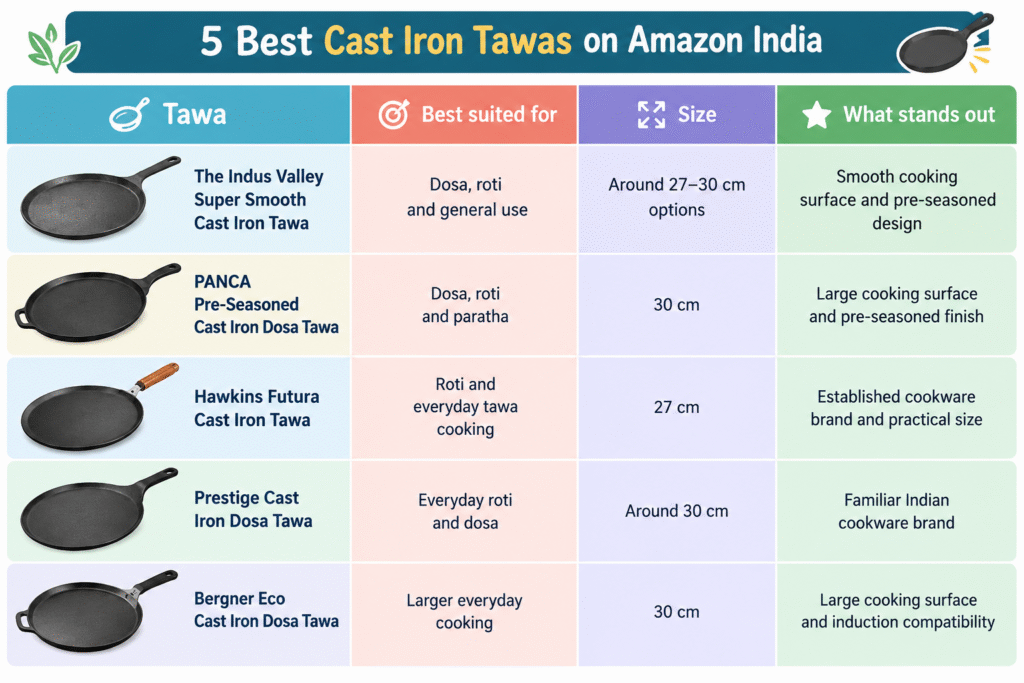
1. The Indus Valley Super Smooth Cast Iron Tawa
Best for: Dosa, roti and buyers who prefer a smoother cooking surface
The Indus Valley has several cast iron tawa models, including its Super Smooth range. The manufacturer’s current range includes pre-seasoned tawas in different sizes and describes them as suitable for gas and induction cooking.
The main reason to consider this range is the surface finish.
If you mainly want a tawa for dosa, the cooking surface deserves more attention than it usually gets. A very rough surface can make spreading and releasing dosa more frustrating, particularly when you are still getting used to cast iron.
The Super Smooth models are designed around a smoother surface, which makes them worth considering for people who want one tawa for both dosa and everyday flatbreads.
Why I like it
- Smooth-finish options are available
- Pre-seasoned versions are available
- Useful for both roti and dosa
- Several sizes are available
- Suitable models can be used on induction as well as gas
Keep in mind
A smooth surface does not automatically mean that food will never stick. Your heating, seasoning and cooking technique still matter.
Also, some larger models are quite heavy. For example, current listings for the 12-inch version show a weight of around 2.3 kg, so check the weight before ordering.
My take
If dosa is one of your main reasons for buying cast iron, I would put this range near the top of your list.
2. PANCA Pre-Seasoned Cast Iron Dosa Tawa
Best for: A large tawa for dosa, roti and paratha
PANCA offers a 30 cm pre-seasoned cast iron dosa tawa that is listed for both gas and induction cooking.
The 30 cm cooking area is useful if you prefer making larger dosas or want plenty of space when cooking parathas.
It is also a reasonable size for general family cooking. But remember that a 30 cm cast iron tawa is not a lightweight pan. If you have never used cast iron before, the weight is something you should consider seriously.
Why I like it
- Large 30 cm cooking surface
- Pre-seasoned
- Suitable for gas and induction
- Useful for dosa, roti and paratha
- Good option if you prefer a larger cooking area
Keep in mind
A larger tawa needs more storage space and can be harder to lift.
Also, pre-seasoned does not mean you can forget about seasoning and care altogether.
My take
This is worth considering if cooking surface matters more to you than keeping the tawa light and easy to handle.
3. Hawkins Futura Cast Iron Tawa
Best for: For those who prefer established Indian cookware brands, this brand is an ideal choice.
Hawkins Futura has a cast iron dosa tawa in its range, including a 27 cm model listed for roti and dosa. Here, the current products are described as pre-seasoned cast iron.
The 27 cm size sits in a useful middle ground. It gives you enough cooking space for regular home use without going straight to one of the very large tawas.
That makes it worth considering if you want a cast iron tawa mainly for everyday roti, chapati and occasional dosa.
Why I like it
- Practical 27 cm size
- Pre-seasoned
- Suitable for roti and dosa
- Established Indian cookware brand
- A useful size for everyday cooking
Keep in mind
The cooking surface and weight should still be checked against the latest product specification before buying.
Do not choose it only because you recognise the brand. Compare the size, weight and surface with the other tawas on your shortlist.
My take
If you want a moderately sized cast iron tawa from a familiar cookware brand, this one deserves a look.
4. Prestige Cast Iron Dosa Tawa
Best for: Everyday Indian cooking and buyers who already trust the Prestige range
Prestige also offers cast iron dosa tawas, including a 30 cm model.
A 30 cm tawa gives you plenty of room for dosa, paratha and other flatbreads. It can also be useful when cooking several items in succession.
The main thing I would consider here is not simply the brand name but whether the particular model’s weight and surface suit your routine.
Why I like it
- Large cooking surface
- Suitable for common Indian tawa cooking
- Well-known cookware brand
- Useful for dosa and flatbreads
Keep in mind
Cast iron is heavy, and a larger tawa can become noticeably tiring if you repeatedly lift it during cooking.
Before buying, check the current listing for:
- Exact diameter
- Weight
- Cooktop compatibility
- Seasoning information
- Handle design
- Manufacturer instructions
My take
A sensible option if you want a large everyday cast iron tawa from a familiar Indian brand.
5. Bergner Eco Cast Iron Dosa Tawa
Best for: Buyers looking for another 30 cm cast iron option
The Bergner Eco Cast Iron Dosa Tawa is currently listed in a 30 cm size and is available on Amazon India.
The main attraction here is the generous cooking surface. A 30 cm tawa gives you plenty of room for larger dosas and flatbreads.
Bergner is also a useful alternative if you have already compared the more familiar Indian cookware brands and want another option to consider.
Why I like it
- 30 cm cooking surface
- Designed for dosa-style cooking
- Suitable option for larger flatbreads
- Available through Amazon India
Keep in mind
With any large cast iron tawa, check the weight before ordering. A large cooking surface is useful, but only if you are comfortable handling the tawa.
My take
A good alternative to compare with the other 30 cm options, particularly if you want a large tawa but do not want to limit your choice to one or two brands.
Which One Should You Buy?
You do not necessarily need the same tawa that I would choose.
The better question is:
What will you cook most often?
If dosa is your main priority
Then you need a fairly large tawa with a smooth surface so that you can spread the dosa batter properly.
The Indus Valley Super Smooth range is particularly worth considering here.
If you mainly make roti and chapati
You do not necessarily need the biggest tawa available.
You will need a medium-sized pan that is relatively lighter than a large one, so you can easily lift and move it.
Hawkins Futura’s 27 cm option is worth considering.
If you make large dosas and parathas
A 30 cm tawa gives you more room.
PANCA, Prestige and Bergner all have large options worth comparing.
If you are buying your first cast iron tawa
Do not start with the heaviest model simply because heavier sounds better.
For your first use, choose a model of a size and weight that you can handle easily.
That matters more than having the biggest cooking surface.
What factors should be considered when buying a cast iron tawa?
If you have decided to buy a cast-iron tawa, keeping a few things in mind will make the purchase much easier for you.
Here are the points I would check before buying.
1. Choose the Right Size
Size affects both cooking comfort and handling.
A very small tawa may feel easy to use but leave you struggling to spread a large dosa.
A very large one gives you more cooking space but takes up more storage space and can be heavier.
For many Indian kitchens, something around 26–30 cm can be a useful range. But it is not a hard-and-fast rule that you have to buy that specific one.
If you mostly make small rotis for one or two people, a smaller tawa may be perfectly adequate.
If you make large dosas regularly, a larger surface makes more sense.
2. Do Not Ignore Weight
This is probably the most overlooked factor when buying cast iron.
A tawa can sit comfortably on your stove while cooking, so you may think its weight does not matter.
It does.
You will need to:
- Move it onto the stove
- Take it off after cooking
- Wash it
- Dry it
- Store it
- Sometimes lift it while cooking
And when the tawa is hot, handling it becomes even more important.
From my own experience with cast iron cookware, a manageable weight makes a big difference to how often you actually want to use it.
So before buying, ask yourself:
Can I comfortably handle this tawa when it is hot and after several minutes of cooking?
Look at the Cooking Surface
The cooking surface is particularly important if dosa is on your menu.
A very rough surface may take more time and seasoning before you become comfortable cooking delicate foods.
A smoother surface can be easier to work with.
But do not assume that “smooth” means “automatically non-stick.”
Food release also depends on:
- Seasoning
- Preheating
- Amount of oil
- Batter consistency
- Cooking temperature
- Your technique
4. Pre-Seasoned or Not?
You will usually see cast iron tawas described as either pre-seasoned or unseasoned.
For a first-time buyer, pre-seasoned cookware can be the easier starting point.
It gives you an initial protective cooking surface instead of making you start the seasoning process from scratch. Nevertheless, you must always adhere to the specific guidelines provided by the manufacturer when using the vessel.
Over time, regular use and proper maintenance can help maintain the seasoning.
5. Check the Handle
The handle may look like a small detail, but it matters with cast iron because the cookware itself is heavy.
Look for a handle that:
- Gives you a secure grip
- Is comfortable to hold
- Does not make the tawa awkward to move
- Gives enough clearance from the hot cooking surface
Some larger tawas may also have a helper handle.
If you have limited hand strength, pay extra attention to this part.
6. Check Cooktop Compatibility
Most modern cast iron cookware can work with several types of cooktops, but if you use induction you should still check the manufacturer’s information for the exact model.
Do not assume beforehand that all Tawa labeled as ‘cast iron’ will perform the same way on a cooktop.
7. Think About What You Actually Cook
This is more useful than choosing based on brand.
For roti and chapati
A manageable size and comfortable weight are important.
For paratha
You may want a little more cooking space because parathas can require more room than small rotis.
For dosa
Surface smoothness and diameter become more important.
For chilla and uttapam
A stable, evenly heated surface is useful.
For general tawa cooking
Choose a size that is easy to use and store.
Cast Iron Tawa vs Non-Stick Tawa
To understand why you should choose a cast-iron tawa over the far more convenient non-stick variety, you need to have a comprehensive understanding of all the. characteristics of cast iron.
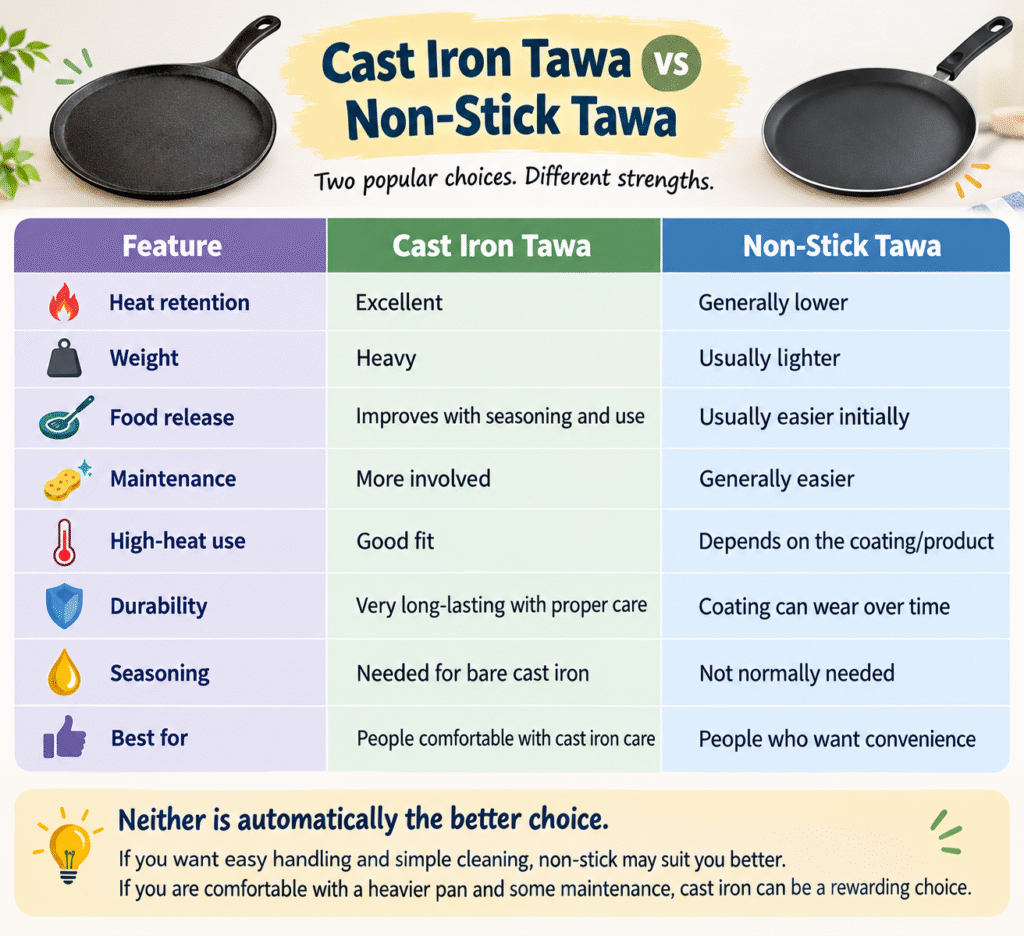
Neither is automatically the better choice.
If you want easy handling and simple cleaning, non-stick may suit you better.
If you are comfortable with a heavier pan and some maintenance, cast iron can be a rewarding choice.
How to use a cast iron tawa for the first time
If your tawa arrives pre-seasoned, follow the manufacturer’s instructions first.
Before your first proper cooking session:
- Wash it according to the manufacturer’s directions.
- Dry it completely.
- Add a very small amount of oil as needed.
- Heat it gradually.
- Start with simple foods while you get used to the tawa.
- Avoid expecting perfect food release from the first use.
Cast iron tends to reward regular use.
The cooking surface can change with time as seasoning develops, so your first few cooking sessions may not tell you exactly how the tawa will perform after several weeks of use.
How to Clean a Cast Iron Tawa
You do not need a complicated cleaning routine.
After cooking:
- Allow the tawa to cool enough to handle safely.
- Remove food residue.
- Wash according to the manufacturer’s instructions.
- After washing your cast iron tawa, dry it completely and apply a thin layer of cooking oil before storing it. For more practical advice, read this guide to cleaning and caring for cast iron cookware.
- Store it somewhere dry.
The main thing is simple:
Do not leave bare cast iron wet.
Moisture can lead to rust.
Also, do not put a traditional bare cast iron tawa away while it is still damp.
Common Mistakes When Buying a Cast Iron Tawa
Buying the heaviest one
Heavier does not automatically mean better.
A tawa that is difficult to lift may end up sitting unused in your kitchen.
Buying the largest size
A large tawa sounds useful until you realise it does not fit comfortably on your stove or in your storage space.
Ignoring the surface
If you mainly make dosa, the cooking surface deserves serious attention.
Assuming pre-seasoned means maintenance-free
Many people mistakenly believe that “pre-seasoned” means no maintenance is required. That is not the case at all; pre-seasoned items also require proper care.
Choosing by brand alone
A product from a specific brand might give you peace of mind, but the real issue is which model is right for you.
Compare the size, weight, surface, handle and cooktop compatibility.
Expecting instant non-stick performance
Cast iron cookware becomes ideal for cooking only through regular use and the proper ‘seasoning’ process (creating a special coating using oil and heat); So, to get the best results from this, you will need to invest some time and effort.
Is a Cast Iron Tawa Worth Buying?
For the right cook, yes.
A cast iron tawa makes sense if you:
- Make roti, chapati, paratha or dosa regularly
- Like steady, retained heat
- Do not mind a heavier pan
- Are willing to maintain the surface
- Want cookware that can serve you for a long time
However, buying cast iron would not be the right decision for you if the following points are on your list of preferences:
- Very lightweight cookware
- Almost no maintenance
- Easy food release straight out of the box
- A tawa that is effortless to lift and wash
There is no shame in choosing another type of tawa if it fits your kitchen better.
My Final Picks
After looking at the five options from the point of view of size, intended use, surface and everyday practicality, I would divide them like this:
Best for dosa and a smoother surface
The Indus Valley Super Smooth Cast Iron Tawa
Best large-surface option
PANCA 30 cm Pre-Seasoned Cast Iron Dosa Tawa
Best established-brand option
Hawkins Futura Cast Iron Tawa
Best large everyday option from a familiar Indian brand
Prestige Cast Iron Dosa Tawa
Good alternative large tawa
Bergner Eco Cast Iron Dosa Tawa
These are not rankings based on personal laboratory testing. They are practical recommendations based on the product specifications, intended use and information available for the listed models. Always check the current Amazon listing before buying because specifications, sellers and prices can change.
❓ FAQs
Is cast iron good for making dosa?
Yes, it can be. A properly seasoned cast iron tawa can work very well for dosa. However, surface condition, preheating and cooking technique make a big difference.
Is cast iron good for roti?
Yes. A cast iron tawa can provide stable heat for roti and chapati. Choose a size and weight that you can comfortably handle.
Is a heavier cast iron tawa better?
Not necessarily.
A heavier tawa can provide stability and retain heat well, but too much weight can make everyday cooking uncomfortable.
Is pre-seasoned cast iron better for beginners?
It can be easier for beginners because the initial seasoning has already been done. But it still needs proper care.
Can a cast iron tawa be used on induction?
Many cast iron tawas are induction compatible, but check the manufacturer’s specification for the exact model before buying.
How big should a cast iron tawa be?
For many home kitchens, around 26–30 cm is a practical range. The right size depends on how many people you cook for, the size of your rotis or dosas and how much weight you are comfortable handling.
Can I use a cast iron tawa every day?
Yes, provided you are comfortable with its weight and care requirements. In fact, regular use can be a good way to maintain the cooking surface of seasoned cast iron.
Cooking in iron cookware can increase the amount of iron in some foods, but the amount varies with the food and cooking conditions. A USDA research article on iron pots and food explains this effect.
🏁 Final Verdict (Don’t Skip This)
A cast iron tawa is not something I would recommend simply because it is durable or traditional.
Buy one because it fits your cooking.
If dosa is your priority, pay attention to the surface and diameter. If you mainly make roti, weight and comfortable handling may matter more. If you make both, look for a size that gives you enough cooking space without becoming a burden to lift and clean.
And before clicking the Buy Now button, take one last look at the weight.
It is a small detail on an Amazon product page, but it can make a surprisingly big difference once the tawa becomes part of your everyday kitchen.