Stainless Steel Cookware Buying Guide: 9 Essential Things to Know Before You Buy
Every kitchen is different. The right cookware depends on who uses the kitchen, what they usually cook, and their everyday eating habits. While you may have different types of cooking equipment, good-quality stainless steel cookware is a great choice for everyday cooking. It is durable, practical, and suitable for preparing a wide variety of dishes.
Choosing stainless steel cookware may seem simple at first, but there is more to consider than just the appearance or the number of pieces in a set. Different cookware can vary in construction, stainless steel grade, thickness, heat distribution, weight, handle design, and compatibility with different cooktops. Understanding these differences can help you choose cookware that suits the way you actually cook.
Stainless steel is a popular choice for Indian kitchens because it is durable, versatile, and suitable for a wide range of everyday cooking. However, not every stainless steel pan or pot will offer the same cooking experience. For example, triply cookware is constructed differently from basic single-layer stainless steel, and some cookware may work on induction while others may not.
In this guide, we will cover 9 essential things you should know before buying stainless steel cookware. We will look at construction, stainless steel grades, cookware thickness, induction compatibility, size, handles, weight, maintenance, and other practical factors that can affect your buying decision.
The goal is not simply to recommend the most expensive cookware. Instead, this guide will help you understand what to look for so you can choose stainless steel cookware that fits your cooking habits, kitchen setup, and budget.
If you are already ready to compare specific cookware sets, you can also check our detailed guide to the Best Stainless Steel Cookware on Amazon India (2026), where we review and compare seven popular options.
Stainless Steel vs. Triply Stainless Steel: What’s the Difference?
One of the most common sources of confusion is the difference between ordinary stainless steel cookware and triply stainless steel cookware.
Traditional stainless steel cookware
Traditional cookware may use a single primary stainless steel layer or a base designed to improve heat distribution.
Its main advantages are:
- Durability
- Easy maintenance
- Familiar cooking characteristics
- Generally lower cost
However, stainless steel itself is not an especially strong heat conductor. Depending on the construction, heat can be concentrated around the area directly above the burner.
Triply stainless steel cookware
Triply cookware typically uses three bonded layers:
Stainless steel → heat-conducting core → stainless steel
The middle layer is commonly aluminium, while the cooking surface remains stainless steel.
The purpose of this construction is to improve heat distribution while retaining the durability and cooking characteristics of stainless steel.
Quick comparison
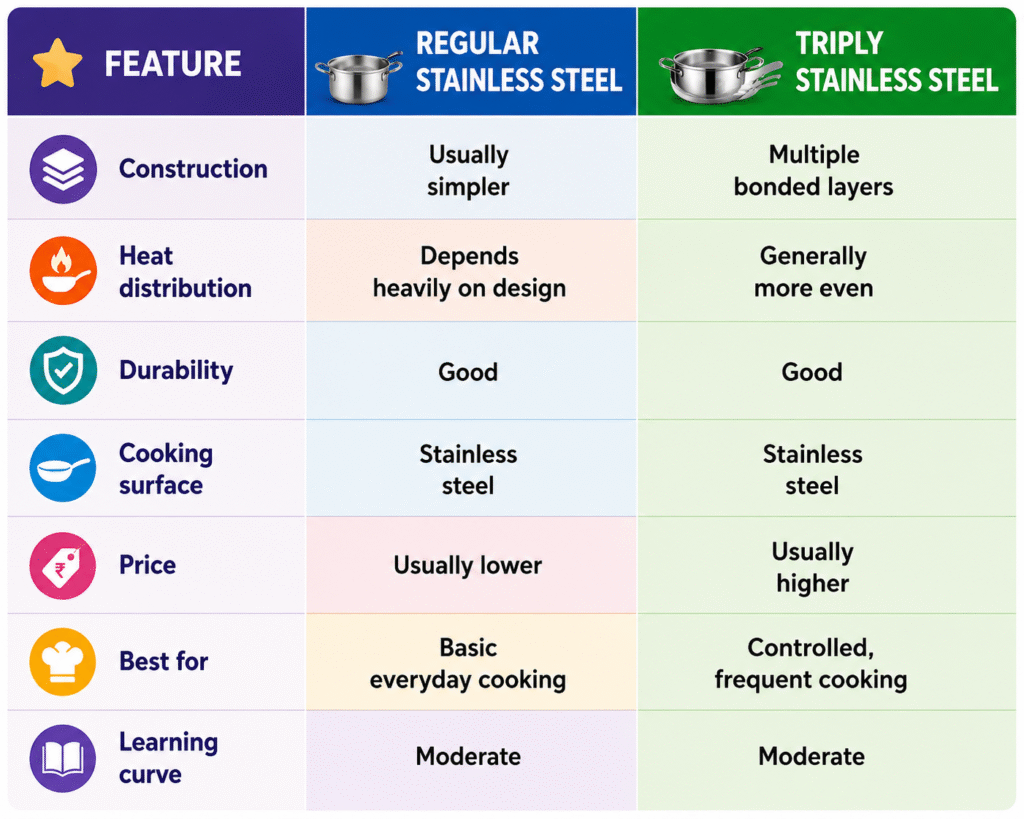
Triply isn’t automatically “better” for every person.
If you mostly boil water, cook rice, prepare simple dishes, or use cookware occasionally, regular stainless steel may be perfectly adequate.
If you cook frequently and want more controlled heat distribution, triply cookware may be worth the additional investment.
How to Choose the Right Stainless Steel Cookware
Buying the most expensive cookware isn’t necessarily the best decision.
Instead, consider these factors.
1. Check the Construction
Look at how the cookware is made.
If you’re considering triply cookware, check whether the product is actually constructed with bonded layers rather than assuming that the word “triply” means the same thing across every product.
2. Choose the Right Size
Think about how much food you normally cook.
A large family may benefit from larger pots and kadais, while a smaller household may find smaller vessels more practical.
Don’t buy a large set simply because it contains more pieces.
If you’re comparing different cookware materials and trying to decide which pieces you actually need, our cookware set buying guide covers these factors in more detail.
3. Check Cooktop Compatibility
If you use induction, make sure the cookware is explicitly listed as induction compatible.
Don’t assume that every stainless steel vessel will work with induction.
If you use both gas and induction, choosing cookware compatible with both can make your kitchen more flexible.
If you’re planning to use an induction cooktop, our guide to choosing induction cookware explains the key factors to check before buying.
4. Look at the Handles
Handles are easy to overlook when buying cookware online.
Check:
- Handle attachment
- Grip
- Shape
- Heat resistance
- Balance
- Whether the handles make storage difficult
A cookware vessel can have excellent construction but still be inconvenient if the handle is uncomfortable.
5. Check the Lids
If a set includes lids, check:
- Material
- Fit
- Handle design
- Ease of cleaning
- Whether you can see through the lid, if that matters to you
6. Consider Maintenance
Stainless steel is durable, but it isn’t completely maintenance-free.
Food can stick if the cookware is used incorrectly or at excessively high temperatures.
Proper heating, suitable oil use, and timely cleaning can make stainless steel easier to use.
7. Compare Warranty
Warranty terms can vary between brands and products.
Check what is covered and for how long before buying.
8. Don’t Ignore Weight
Heavy cookware can feel sturdy, but it may not be convenient for everyone.
If you regularly lift large pots filled with food or water, consider whether the cookware’s weight will be comfortable for you.
Is Stainless Steel Cookware Good for Indian Cooking?
Yes, stainless steel cookware can be very versatile for Indian cooking.
It can be used for tasks such as:
- Cooking dal
- Preparing curries
- Making gravies
- Sautéing vegetables
- Boiling rice
- Preparing soups
- Cooking pasta
- Making milk-based dishes
- Preparing many everyday dishes
However, stainless steel does have a learning curve.
If you’re used to non-stick cookware, you may initially find that food sticks more easily.
The solution isn’t necessarily to use excessive oil.
Instead, learn to control:
- Preheating
- Flame level
- Oil quantity
- Cooking temperature
- When to add ingredients
Once you become familiar with the cookware, it can be very versatile.
How to Prevent Food from Sticking to Stainless Steel Cookware
Sticking is one of the most common complaints from people new to stainless steel cookware.
Try these basic techniques.
1. Preheat the cookware
Heat the pan gradually before adding oil.
2. Don’t use excessively high heat
Stainless steel doesn’t need maximum flame for every recipe.
Medium or medium-low heat is often more appropriate once the cookware is hot.
3. Add oil at the right time
Once the pan is properly heated, add an appropriate amount of oil before adding food.
4. Let food release naturally
If food initially sticks, don’t immediately scrape it aggressively.
Some foods release more easily once they have developed a cooked surface.
5. Avoid overcrowding
Putting too much food into a pan at once can reduce the cooking temperature and increase the chances of sticking.
How to Clean and Maintain Stainless Steel Cookware
Proper care can help stainless steel cookware remain useful for many years.
After cooking
Allow the cookware to cool appropriately before washing it.
Use warm water and a mild dishwashing liquid for routine cleaning.
For stuck food
Instead of aggressively scrubbing the cookware, soak it in warm water first.
For stubborn residue, gentle cleaning methods are usually preferable to harsh abrasive scrubbing.
For stains
Water spots, heat marks, or discoloration can sometimes appear on stainless steel.
These do not necessarily mean the cookware is damaged.
Follow the manufacturer’s cleaning recommendations for the particular cookware.
Avoid unnecessary damage
Don’t use harsh cleaning methods unless the manufacturer specifically recommends them.
Also check the manufacturer’s instructions before putting a particular cookware item in a dishwasher.
Common Mistakes to Avoid When Buying Stainless Steel Cookware
Mistake 1: Choosing only by brand
A well-known brand doesn’t automatically mean every product in its range is right for you.
Compare the particular model.
Mistake 2: Assuming heavier always means better
Weight can be an indicator of construction, but it isn’t the only measure of cookware quality.
Mistake 3: Buying a large set you don’t need
More pieces don’t necessarily mean better value.
Choose cookware based on what you actually use.
Mistake 4: Ignoring dimensions
Capacity alone isn’t enough.
Check the diameter, height, and overall dimensions.
Mistake 5: Forgetting induction compatibility
If you use induction, check this before buying.
Mistake 6: Expecting stainless steel to behave like non-stick cookware
Stainless steel requires different cooking techniques.
Learning how to preheat and control the temperature can make a significant difference.
Mistake 7: Choosing only by appearance
Beautiful cookware may look attractive in your kitchen, but cooking performance, construction, size, usability, and maintenance matter more.
Which Stainless Steel Cookware Should You Choose?
Here’s our simplified recommendation:
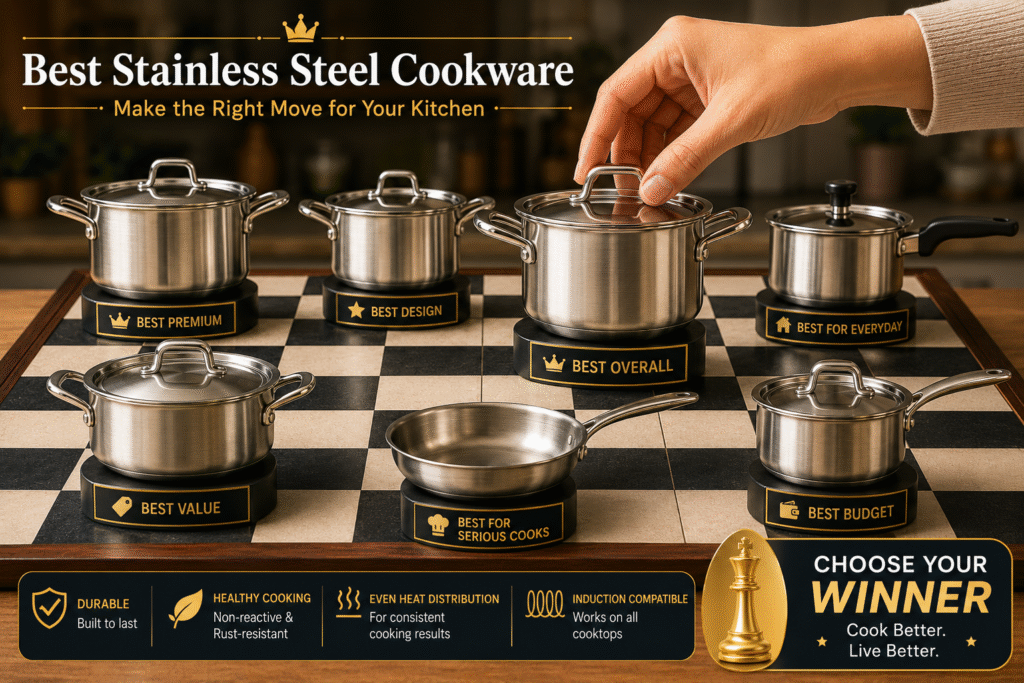
Best Overall for Everyday Cooking
Vinod Platinum Triply Stainless Steel Cookware Set
A good option to consider if you want triply construction for regular home cooking.
Best Premium Choice
Stahl Artisan Triply Cookware Set
Suitable for buyers who prioritize premium cookware and are comfortable with a higher price.
Best for Style and Performance
Bergner Argent Triply Stainless Steel Cookware Set
Worth considering if appearance and triply construction are both important.
Best for Frequent Cooking
Hawkins Tri-Ply Stainless Steel Cookware
A sensible option for regular cooks who prefer an established cookware brand.
Best Value-Oriented Option
Prestige Tri-Ply Stainless Steel Cookware
Worth comparing if you want tri-ply construction without automatically choosing the most expensive option.
Best Premium Alternative
Meyer Trivantage / Tri-Ply Cookware
Suitable for buyers looking for premium cookware and a wider range of options.
Best Budget-Friendly Option
Amazon Basics Stainless Steel Cookware
Worth considering if keeping the initial cost down is your main priority.
Frequently Asked Questions
Is stainless steel cookware safe for everyday cooking?
Stainless steel cookware is widely used for everyday cooking. The actual construction and material grade can vary between products, so it is sensible to check the manufacturer’s specifications before purchasing.
Is triply cookware better than regular stainless steel cookware?
Not necessarily for everyone.
Triply cookware is designed to improve heat distribution through its layered construction, but it usually costs more. If you cook frequently and value more controlled heating, the additional cost may be worthwhile.
Is Triply Cookware Good for Indian Cooking?
Yes. Its multi-layer construction can be useful for cooking tasks that benefit from more even heat distribution, including sautéing, simmering, and preparing gravies.
Can stainless steel cookware be used on induction?
Many stainless steel cookware products are induction compatible, but not all stainless steel cookware is. Always check the specific product’s specifications.
Why does food stick to stainless steel cookware?
Food can stick when the cookware is not heated appropriately, when the temperature is too high or too low for the food being cooked, or when the food is moved too early.
Learning how to preheat the cookware and control the temperature can make stainless steel easier to use.
Is triply cookware worth the extra money?
It depends on how you cook.
For someone who cooks frequently and wants better heat distribution, triply cookware may justify the additional cost. For occasional cooking or simple boiling tasks, conventional stainless steel cookware may be sufficient.
How long can stainless steel cookware last?
Good-quality stainless steel cookware can last for many years with appropriate use and care. Actual lifespan depends on construction, frequency of use, maintenance, and how the cookware is handled.
Final Thoughts
Choosing stainless steel cookware is less about finding one universally “best” set and more about finding the right cookware for your cooking habits, kitchen, and budget.
If you cook regularly and want better heat distribution, triply cookware is worth considering. If you mainly need simple, durable cookware for everyday tasks, conventional stainless steel may be enough.
Among the products discussed in this guide, the Vinod Platinum Triply is worth considering for balanced everyday use, while Stahl and Meyer may appeal to buyers looking for a more premium option. Hawkins and Prestige are worth comparing for buyers who prefer established brands, while Amazon Basics may suit people who want a more budget-conscious starting point.
Before making your final decision, don’t focus only on the brand name or the number of pieces in a set.
Check the construction, size, capacity, cooktop compatibility, handles, lids, warranty, maintenance requirements, and price.
Most importantly, choose cookware that fits the way you actually cook.
Disclosure: Some links on this page may be affiliate links. If you purchase through an affiliate link, we may receive a commission at no additional cost to you. Our recommendations are intended to provide useful information and are not a substitute for considering your own requirements before making a purchase.