Cast Iron Cookware: Is It Right for Your Cooking? A Practical Buying Guide

Cast iron cookware has a very different feel from most modern kitchen cookware. It is heavy, takes a little time to heat, holds heat for a long time, and needs more care than many lightweight pans.
Hearing all this, anyone might think that this is an extremely troublesome matter.
But if you regularly cook roti, paratha, dosa, vegetables, shallow-fried dishes or foods that benefit from steady heat, cast iron can be a useful addition to an Indian kitchen.
I have cooking experience with cast iron cookware, so I know that its weight and care requirements are things you notice in everyday cooking. A pan may perform well, but that does not automatically make it comfortable for every person or every kitchen.
So, rather than just knowing how good cast iron cookware is, you first need to determine whether it actually fits your lifestyle and daily cooking routine?
Your answer will depend on the food you prepare, the type of cookware you need, how much weight you are comfortable handling, your cooktop, and how much care you are willing to give the pan.
This guide looks at cast iron from that practical point of view. Instead of simply listing its benefits, we will look at how its construction affects cooking, how it behaves with Indian foods, what to check before buying, and when another cookware material may make more sense.
What You’ll Learn In This Cast Iron Cookware Guide
In this guide, we’ll look at the practical things that matter before you buy.
Here’s what you’ll learn:
- What makes cast iron different from other cookware materials
- How cast iron works with Indian cooking, from rotis and dosas to frying and curries
- How thickness, weight and construction affect everyday cooking
- How cast iron behaves on the stove, including heating and heat retention
- The different types of cast iron cookware and what each one is best suited for
- Bare, pre-seasoned and enameled cast iron — what’s different between them
- Seasoning and everyday care, including how much maintenance is really needed
- How to choose the right size and shape for your cooking needs
- What to check before buying cast iron cookware
- How cast iron compares with stainless steel, non-stick and other materials
- Who should consider cast iron — and who may be better off with another option
- Common buying and cooking mistakes to avoid
- Answers to common questions about cast iron cookware
By the end, you should have a clearer idea of whether cast iron suits your cooking style and what to look for if you decide to buy it.
What Makes Cast Iron Different?
Cast iron cookware is made by pouring molten iron into a mould and allowing it to cool into the required shape.
This manufacturing method produces a solid piece of cookware. Unlike thin aluminium pans or many lightweight coated pans, cast iron is normally much thicker and heavier.
That physical construction has a direct effect on the way it cooks.
A cast iron pan can take longer to become properly hot, but once heated, it does not cool down quickly. This makes it useful when you want the pan to maintain a fairly steady cooking temperature.
The same characteristic can also be inconvenient.
If you turn the heat down, cast iron does not immediately respond in the way a thinner pan might. So cast iron is more comfortable for someone who is happy to preheat the pan and cook with steady heat rather than constantly changing the temperature.
You can find cast iron cookware in several forms, including:
- Cast iron tawas
- Dosa tawas
- Kadhais
- Skillets
- Frying pans
- Grill pans
- Dutch ovens
- Paniyaram pans
- Griddles and other specialised cookware
Its large or small size is just as important as its material. A cast iron tawa and a cast iron kadai may be made from the same basic material, but they serve very different cooking needs.

Cast Iron and Indian Cooking: Where Does It Actually Fit?
For an Indian kitchen, the most useful way to understand cast iron is through the foods you already cook.
You do not need to change your entire cooking style just because you buy a cast iron pan.
Roti and paratha
A cast iron tawa can be useful for roti and paratha because the cooking surface can stay hot while several pieces are cooked one after another.
The weight also helps keep the tawa stable on the stove.
However, the tawa can become tiring to lift or move, particularly if you frequently take it off the stove during cooking.
Dosa
Cast iron dosa tawas are popular because the heavy cooking surface can hold heat well.
For dosa, however, the condition of the cooking surface matters. A well-maintained and properly seasoned surface can become easier to cook on with regular use.
Cast-iron skillets—or indeed any cast-iron cookware—are not smooth when new. However, with regular use over time, they become highly prized by cooks.
Shallow frying
Cast iron can work well when you want the pan to remain hot while cooking several pieces of food.
This can be useful for dishes such as cutlets, kebabs, vegetables or other foods that are shallow-fried.
The downside is simple: the pan itself is heavy, and adding oil and food increases the total weight.
Sautéing and tadka
Cast iron can be used for sautéing vegetables and other ingredients.
However, you must keep in mind that once the cooking pan heats up, you need to lower the heat; otherwise, the pan could become extremely hot.
This is particularly relevant when cooking ingredients that can burn quickly.
Curries and acidic ingredients
Bare cast iron needs a little more thought when cooking foods containing acidic ingredients for extended periods. Tomatoes, tamarind and similar ingredients can interact with the cooking surface, especially when the seasoning is weak or damaged.
That does not mean you can never cook such foods in bare cast iron. It means you should consider the condition of the seasoning and the cooking time.
For frequent long cooking of acidic dishes, enameled cast iron can be a different option because the food does not come into direct contact with bare iron.
Roasting and high-heat cooking
Cast iron is comfortable with cooking methods where strong, steady heat is useful.
It can be suitable for roasting, browning, grilling and shallow frying.
So, if your kitchen involves a lot of traditional Indian cooking rather than only light, quick meals, cast iron can have a practical place.
Thickness and Construction Matter More Than You May Think
When shopping for cast iron, many people stop after seeing the words “cast iron.”
That is not enough.
Two cast iron pans can have noticeably different weights, shapes, surfaces and handling characteristics.
Thickness
Cast iron cookware is generally thicker than many other cookware materials.
A thicker body can contribute to heat retention and durability, but it also adds weight.
Do not assume that thicker automatically means better.
For everyday cooking, the more useful question is whether the construction gives you a good balance between:
- Heat retention
- Cooking area
- Weight
- Stability
- Ease of handling
A very thick and heavy pan may hold heat extremely well, but if you avoid using it because it is difficult to lift, its theoretical advantage does not help much.
Weight distribution
The total weight is not the only thing to notice.
Look at how the weight is distributed.
A wide tawa with a comfortable edge can feel different from a deep kadai with a long handle. A skillet with a helper handle can be easier to move than one without it.
When comparing products, look at:
body weight + handle design + cooking surface + food capacity
rather than considering weight alone.
Cooking surface
The surface finish can also differ from one product to another.
Some cast iron cookware has a relatively smooth surface, while some has a more textured finish.
For foods such as dosa, roti or paratha, the cooking surface can make a noticeable difference to how comfortable the pan feels during use.
Always check the manufacturer’s product information rather than assuming that every cast iron pan has the same finish.
How Cast Iron Behaves on the Stove
You need to understand this matter very well before purchasing.
Cast iron is good at holding heat.
It is not particularly good at changing temperature quickly.
These two characteristics are related but not the same.
Imagine you are cooking a vegetable dish and suddenly reduce the flame.
A thin pan can respond relatively quickly.
A hot cast iron pan may continue giving off considerable heat because the cookware itself has already stored a lot of heat.
The reverse is also true. When you place cold food into a properly heated cast iron pan, the pan can retain heat better than a lightweight pan.
A simple way to think about it
Cast iron:
- Takes time to heat
- Holds heat well
- Gives steady cooking heat
- Takes time to cool
- Works well with preheating and steady cooking
This makes cast iron particularly useful for cooking where you want a stable hot surface.
It may feel less convenient if your cooking style involves constantly moving between very high and very low heat.
What Types of Cast Iron Cookware Can You Buy?
Choosing the right shape is often more important than buying the largest or heaviest piece.
1. Cast Iron Tawa
A tawa is useful for:
- Roti
- Paratha
- Dosa
- Chilla
- Other flatbreads
If these foods are common in your kitchen, a tawa may be more useful than buying a general-purpose skillet.
2. Cast Iron Kadai
A kadai gives you deeper sides than a tawa.
It can be useful for:
- Sautéing
- Shallow frying
- Frying
- Vegetables
- Some curry preparations
The deeper body also makes it easier to handle food that needs stirring.
3. Cast Iron Skillet or Frying Pan
A skillet is a versatile option for:
- Searing
- Browning
- Shallow frying
- Roasting
- Grilling
- Cooking vegetables or meat
It can be useful if you want one cast iron pan for several cooking jobs.
4. Grill Pan
A grill pan has raised ridges designed to create grill marks and keep some of the food away from direct contact with the flat cooking surface.
It is more specialised, so it may not be the first piece to buy if you mainly cook Indian everyday meals.
5. Paniyaram Pan
This is designed specifically for paniyaram and similar preparations.
If you regularly make paniyaram, the shape has a clear purpose. If you do not, buying one simply because it is cast iron may not be very useful.
6. Enameled Cast Iron
Enameled cast iron has an enamel layer over the iron.
It avoids the normal seasoning requirement of bare cast iron and can be more convenient for cooking foods where bare cast iron needs extra consideration.
The trade-offs are price, weight and the need to protect the enamel from damage.
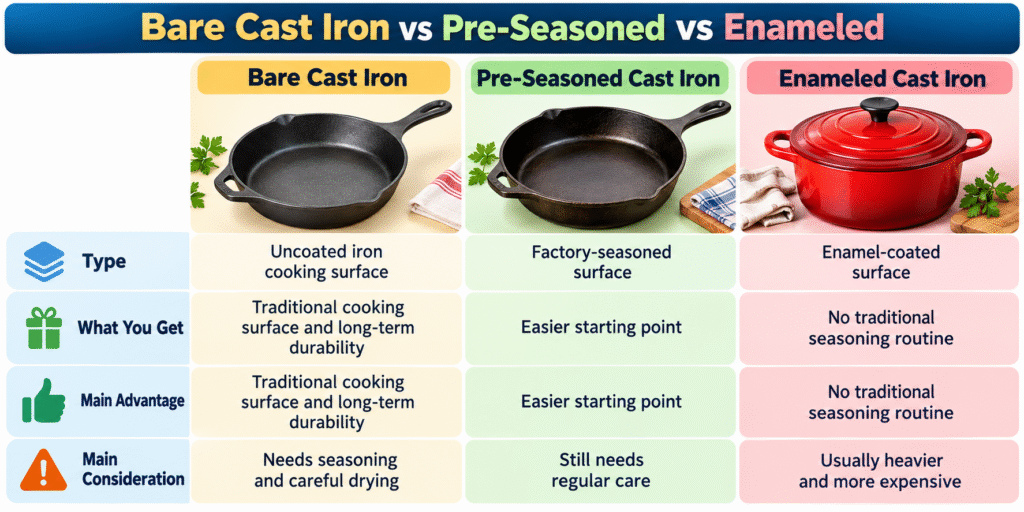
Is pre-seasoned cast iron maintenance-free?
No.
Pre-seasoning gives you a starting layer. It does not mean you can wash the pan carelessly, leave it wet or ignore the condition of the surface.
The cooking surface still needs appropriate care.
Does Cast Iron Really Need Seasoning?
If you are buying traditional bare cast iron, seasoning is part of owning it.
Seasoning is not simply putting oil on the pan and leaving it there. Proper seasoning involves heating a thin layer of cooking oil so that it forms a bonded protective layer on the iron surface.
With regular use and proper care, the cooking surface can become more comfortable for food release.
Seasoning also helps protect bare iron from moisture and rust.
But there is an important difference between seasoned cast iron and a modern non-stick coated pan.
They are not the same thing.
A non-stick pan relies on a manufactured coating. Cast iron develops its cooking surface through seasoning and continued use.
That means the surface can change over time.
Is maintaining cast iron really a time-consuming and laborious task?
This is where you need to be honest about your own routine.
Bare cast iron does need more attention than many stainless steel or coated pans.
The basic routine is straightforward.
1. Do not leave it soaking
Avoid leaving bare cast iron in water for a long period.
Wash it after use and do not allow moisture to sit on the surface.
2. Dry it properly
Drying is important because prolonged moisture can encourage rust.
Do not put a wet cast iron pan away in a cupboard.
3. Keep an eye on the seasoning
If the surface becomes patchy, dry-looking or starts losing its protective layer, the pan may need attention.
Re-seasoning can restore the surface.
4. Store it somewhere dry
A dry storage area is particularly important for bare cast iron.
If you stack cookware, make sure moisture is not trapped between pieces.
5. Follow the manufacturer’s instructions
Not every cast iron product has exactly the same care instructions.
This is especially important for enameled cookware, where the care requirements are different from bare cast iron.
How Heavy Is Cast Iron in Everyday Use?
This is one question I would never ignore before buying cast iron.
The weight can be perfectly manageable when the pan is empty.
The experience changes when you add food.
Think about lifting a tawa after making several rotis or moving a kadai containing a curry. You are not lifting the cookware alone anymore.
Before buying, ask yourself:
Can I comfortably lift, turn and move this cookware when it is full?
If the answer is uncertain, look carefully at the listed weight and dimensions before ordering.
For some people, the weight is reassuring because the cookware stays firmly on the stove.
For others, it becomes a daily inconvenience.
Neither reaction is wrong. It depends on your kitchen routine.
What Size Cast Iron Cookware Should You Choose?
Do not choose the size only according to family size.
Also consider how much food you normally cook and how comfortable you are handling the cookware.
For one or two people
A smaller tawa, skillet or kadai may be easier to manage.
You may sacrifice some cooking area, but the lower weight can make everyday use more comfortable.
For a small family
A medium-sized piece can offer a useful balance between cooking capacity and handling.
For larger quantities
A larger pan can be useful when you regularly cook for several people.
But remember that increasing the diameter or depth can also increase the total weight.
So the decision should be:
Cooking quantity + pan size + weight + storage space
not simply “bigger is better.”
Choose the Shape According to What You Cook
Before buying, think about your most common dishes
| Your Cooking | Cast Iron Shape to Consider |
| Roti and paratha | Tawa |
| Dosa | Dosa tawa |
| Paniyaram | Paniyaram pan |
| Shallow frying | Kadai or skillet |
| Sautéing vegetables | Kadai or skillet |
| Searing and browning | Skillet |
| Grilling | Grill pan |
| Slow cooking | Deep pan or Dutch oven |
This approach can prevent a common mistake: buying a general-purpose cast iron pan when what you actually need is a specific shape.
10 Things to Check Before Buying Cast Iron Cookware
The material is only the starting point. Before placing an order, check the actual product.
- Check the weight
Look for the manufacturer’s listed weight.
If the information is available, compare it with cookware you already use so you have a realistic idea of how heavy it will feel.
- Check the diameter and depth
A 28 cm tawa and a 28 cm deep pan will not have the same practical use.
Look at both width and depth.
- Check the thickness and construction
Do not judge quality from thickness alone.
Look for a construction that gives you a sensible balance of strength, heat retention and manageable weight.
- Choose the right shape
Tawa, kadai, skillet and paniyaram pan are not interchangeable.
Choose your cookware based on your cooking style.
- Look at the handle
A secure handle is particularly important with heavy cookware.
If the pan is large, a helper handle can make lifting and moving it easier.
- Check whether it is pre-seasoned
For someone new to cast iron, a pre-seasoned product may be easier to start with.
But remember that it still needs care.
- Check the cooking surface
Look at the manufacturer’s description and product photographs.
The surface finish can affect how the cookware feels during cooking.
- Confirm cooktop compatibility
Before selecting cookware, the first thing you must check is whether it is suitable for your stove.
This is especially important if you use an induction cooktop.
Do not assume that every cast iron product is marketed for every type of cooktop.
- Decide whether you need a lid
A lid can be useful for cooking dishes that need covered cooking, simmering or braising.
But if you mainly want a tawa for roti or dosa, a lid is obviously not important.
- Read warranty and care information
Before buying branded cookware, check the manufacturer’s warranty, usage instructions and maintenance recommendations.
This information can tell you more about the product than a long list of marketing claims.
Cast Iron vs Other Cookware Materials
Cast iron is only one option for a kitchen
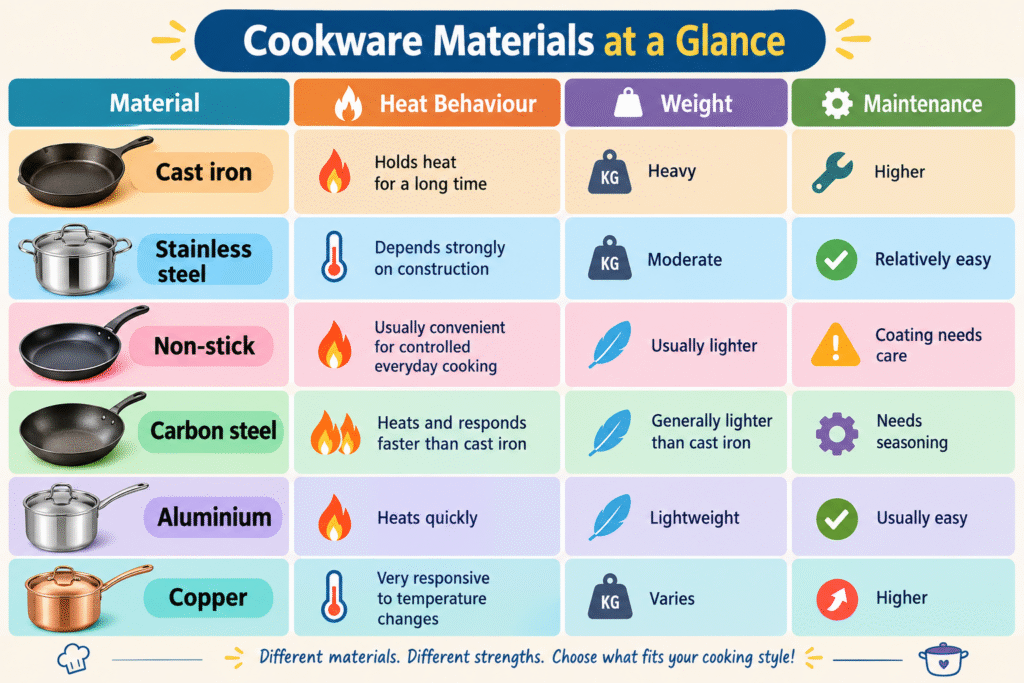
There is no need to replace all your cookware with one material.
A kitchen can use different materials for different jobs.
For example, you may prefer cast iron for a tawa while using stainless steel for curries or another pan for foods where easy release is the main concern.
If you want a broader look at cookware materials, you can also read our 7 Best Cookware Materials for Your Kitchen guide.
Who Is Cast Iron Actually Suitable For?
Cast iron may fit your kitchen well if several of these sound familiar:
- You regularly cook Indian flatbreads such as roti, paratha or dosa.
- You like a pan that stays hot once heated.
- You often cook using medium or high heat.
- You want cookware that can remain useful for many years.
- You do not mind a heavier pan.
- You are willing to dry and maintain bare cast iron properly.
- You enjoy cooking and do not mind spending a little extra time looking after cookware.
But cast iron may feel inconvenient if:
- You strongly prefer lightweight cookware and no need to seasoning.
- You often need to move pans around while cooking.
- You want very quick temperature changes.
- You want cookware that can simply be washed and put away wet.
- Easy food release is your main priority.
After reading the reasons mentioned above, rather than simply asking whether cast iron is good, it would be more practical to assess how well its specific characteristics align with your daily cooking habits.
Should Cast Iron Be Your Main Cookware?
Not necessarily.
For many kitchens, cast iron works better as one useful piece of cookware rather than the only material used for everything.
For example:
Cast iron tawa → roti, paratha and dosa
Cast iron skillet → searing, browning and shallow frying
Cast iron kadai → sautéing, frying and selected Indian dishes
Then you can use other cookware materials for tasks where they are more convenient.
This approach also removes the pressure of finding one “perfect” cookware material.
Common Buying Mistakes to Avoid
Buying the heaviest pan because it looks stronger
More weight is not automatically more useful.
If the cookware is uncomfortable to lift, you may end up using it less often.
Choosing a large pan without checking the weight
Cooking capacity matters, but so does handling.
Remember that the pan becomes heavier after you add food.
Assuming pre-seasoned means maintenance-free
It does not.
The seasoning gives you a starting surface, but you still need to clean, dry and care for the cookware properly.
Buying the wrong shape
A skillet will not replace a dosa tawa if dosa is your main reason for buying cast iron.
Think about the actual cooking task first.
Ignoring the handle
A heavy pan needs a handle that feels secure.
This becomes even more important with larger cookware.
Assuming all cast iron behaves exactly the same
Thickness, surface finish, dimensions, handles and construction can vary.
Read the product specifications instead of relying only on the material name.
Using it for every dish
If you think you should use only cast-iron cookware for your daily cooking, that would not be the right decision. Reserve cast iron for dishes that require both time and patience to prepare.
A Simple Cast Iron Buying Checklist
Before buying, ask yourself:
☐ What will I cook most often in it?
☐ Do I need a tawa, kadai, skillet or another shape?
☐ Is the weight, diameter and depth comfortable for me?
☐ Is the cookware bare, pre-seasoned or enameled?
☐ What maintenance does the manufacturer recommend?
☐Is the cookware suitable for the type of cooking I do?
☐ Is it compatible with my cooktop?
☐Is the handle sturdy or suitable for a heavy pan?
☐ Do I need a lid?
☐ Do I have enough storage space?
☐ Does the price make sense for how often I expect to use it?
If you can answer these questions before buying, you are much less likely to choose cookware simply because it looks impressive in a product photograph.
Frequently Asked Questions About Cast Iron Cookware
Is cast iron good for Indian cooking?
Yes, cast iron can work well for many Indian cooking tasks, including roti, paratha, dosa, shallow frying, sautéing, roasting and some curry preparations.
Its strong heat retention can be useful when a recipe benefits from a hot, steady cooking surface.
Is cast iron better than stainless steel?
Neither material is automatically better for every cooking situation.
Cast iron holds heat very well but is heavier and needs more care. Stainless steel is generally easier to maintain and can be very versatile, but cooking performance depends heavily on its construction and cooking technique.
Choose according to the dishes you prepare and the type of cooking experience you prefer.
Is cast iron good for dosa?
A cast iron dosa tawa can be a good option if you are comfortable maintaining and seasoning the cooking surface.
A new pan may take some time and use before you become comfortable with its cooking behaviour.
Can I cook curry in cast iron?
Yes, but bare cast iron needs some care when cooking acidic foods, especially for longer cooking periods.
If acidic dishes are a regular part of your cooking, consider the condition of the seasoning or whether an enameled cast iron option would be more suitable.
Does cast iron need seasoning?
Traditional bare cast iron generally needs seasoning.
Pre-seasoned cookware already has an initial layer, but it still needs proper cleaning, drying and maintenance.
Enameled cast iron does not require the same traditional seasoning routine.
Is cast iron safe for induction cooking?
Cast iron cookware can work with induction cooktops, but you should always check the manufacturer’s information for the particular product.
Also remember that the heavy base can potentially scratch a glass cooktop if the cookware is dragged across the surface.
Why is cast iron so heavy?
Cast iron cookware is generally made with a substantial iron body. Its mass contributes to its ability to retain heat and also helps keep the pan stable during cooking.
The trade-off is that it is harder to lift and move than many lightweight pans.
Is a heavier cast iron pan better?
Not necessarily.
A heavier pan may offer strong heat retention, but it can also be harder to handle.
For everyday cooking, the right balance of construction, cooking area and weight is more useful than simply choosing the heaviest product.
Can I use metal utensils with cast iron?
Traditional bare cast iron is generally more tolerant of metal utensils than many coated non-stick surfaces. However, care should still be taken with the seasoning, and the manufacturer’s instructions should be followed for the specific cookware.
Can cast iron last for many years?
With appropriate use and maintenance, cast iron cookware can be very durable.
Its long service life is one reason people continue to use it.
But durability alone should not determine your purchase. If the cookware is too heavy or inconvenient for your cooking routine, you may not use it often enough to benefit from that durability.
My Experience With Cast Iron: What I Would Look at First
I have cooking experience using cast iron cookware, and one thing becomes clear fairly quickly: the pan’s weight matters almost as much as its cooking performance.
Cast iron can feel very stable on the stove, and once it is properly heated, the steady heat is useful for several types of cooking.
At the same time, it is not the sort of cookware I would choose without thinking about handling.
The experience is different from using a lightweight pan. You need to allow time for heating, pay attention to the heat level because the pan stays hot, and take care of the cooking surface if you are using bare cast iron.
That is why, when I look at cast iron cookware, I would not judge it only by thickness, appearance or claims about durability.
I would first ask:
Will I actually enjoy using this pan in my own kitchen?
That is a much more useful test than simply asking whether cast iron is popular.
Final Thoughts: Is Cast Iron Right for Your Kitchen?
Cast iron can be an excellent fit for some kitchens and an unnecessary burden in others.
Its biggest practical strengths are its ability to hold heat, its stable cooking behaviour and its durable construction.
Its biggest compromises are equally clear: weight, slower temperature response and the extra care required for bare cast iron.
For Indian cooking, a cast iron tawa, kadai or skillet can be particularly useful when you regularly cook foods that benefit from a hot, steady cooking surface.
But you do not have to buy cast iron simply because it is durable or traditional.
Think about your own cooking.
If you enjoy using a heavy pan, regularly cook roti, dosa, paratha, shallow-fried foods or dishes that benefit from steady heat, cast iron may fit naturally into your kitchen.
If you prefer lightweight cookware, quick temperature changes and minimal maintenance, another material may be more comfortable.
The right cast iron cookware is not the biggest or heaviest one you can buy. It is the one whose size, shape, weight, construction and care requirements fit the way you actually cook.